

Schuko, Blue CEE, and Red CEE are the plugs that connect a compatible EV charger to an electrical socket; a separate connector plugs into the car. Which plug you need depends first on the socket available where you charge.
The quick version: choose Schuko for occasional, low-power charging from a suitable household socket in much of mainland Europe. Blue CEE may suit regular charging from a properly installed single-phase industrial socket. Red CEE connects to a compatible three-phase socket — but your car will only charge as fast as its onboard AC charger allows.
Schuko vs Blue CEE vs Red CEE at a Glance
The main difference is the supply type each plug can use. Schuko connects to a household socket, Blue CEE usually connects to a single-phase industrial socket, and Red CEE usually connects to a three-phase industrial socket.
|
Supply-side plug |
Typical European supply |
Example charging current |
Approximate power at the socket |
Best fit |
|
Schuko household plug |
230 V, single-phase |
8–10 A for cautious EV charging |
1.8–2.3 kW |
Occasional top-ups at a checked socket |
|
Blue CEE 16 A |
230 V, single-phase |
Up to 16 A |
3.7 kW |
Regular charging where a suitable 16 A circuit is installed |
|
Blue CEE 32 A |
230 V, single-phase |
Up to 32 A |
7.4 kW |
Faster single-phase charging where the installation and car allow it |
|
Red CEE 16 A |
400 V, three-phase |
Up to 16 A per phase |
About 11 kW |
Three-phase supply with compatible equipment |
|
Red CEE 32 A |
400 V, three-phase |
Up to 32 A per phase |
About 22 kW |
Higher-power charging where supply, charger, and car allow it |
One caution: the 7.4 kW for Blue CEE 32 A is a theoretical maximum at 230 V, and local limits on single-phase EV charging may be lower. These figures are supply-side examples, not promised speeds. A Schuko outlet marked 16 A is not automatically suitable for hours of charging — Germany's ADAC advises limiting a standard household socket to 10 A or less. And a 32 A plug cannot turn a 16 A circuit into a 32 A supply.
What Are These Plugs, and Where Do They Connect?
Schuko and CEE plugs connect your charging equipment to the power supply. They are different from the Type 2 connector that plugs into many EVs in Europe and the UK.
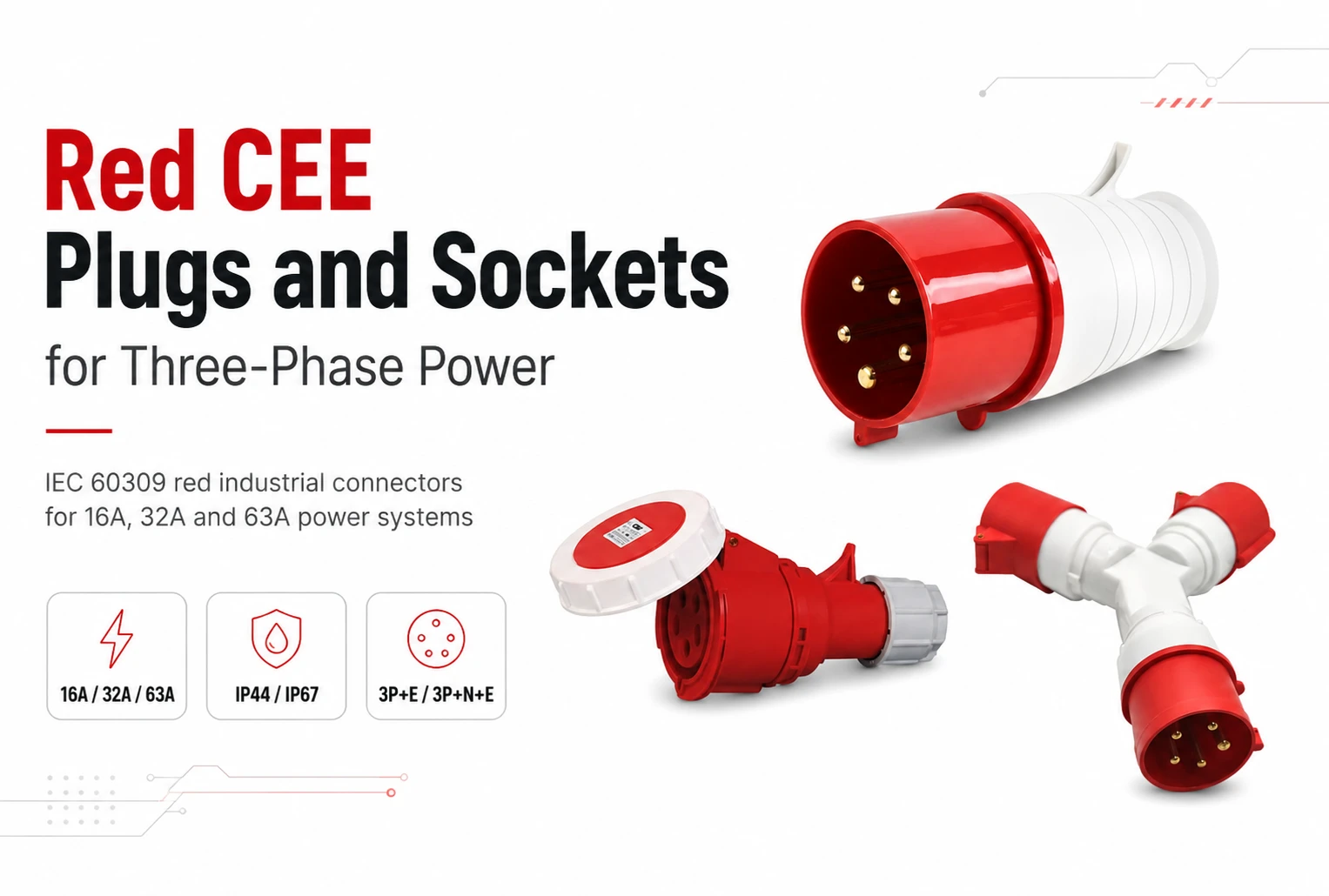
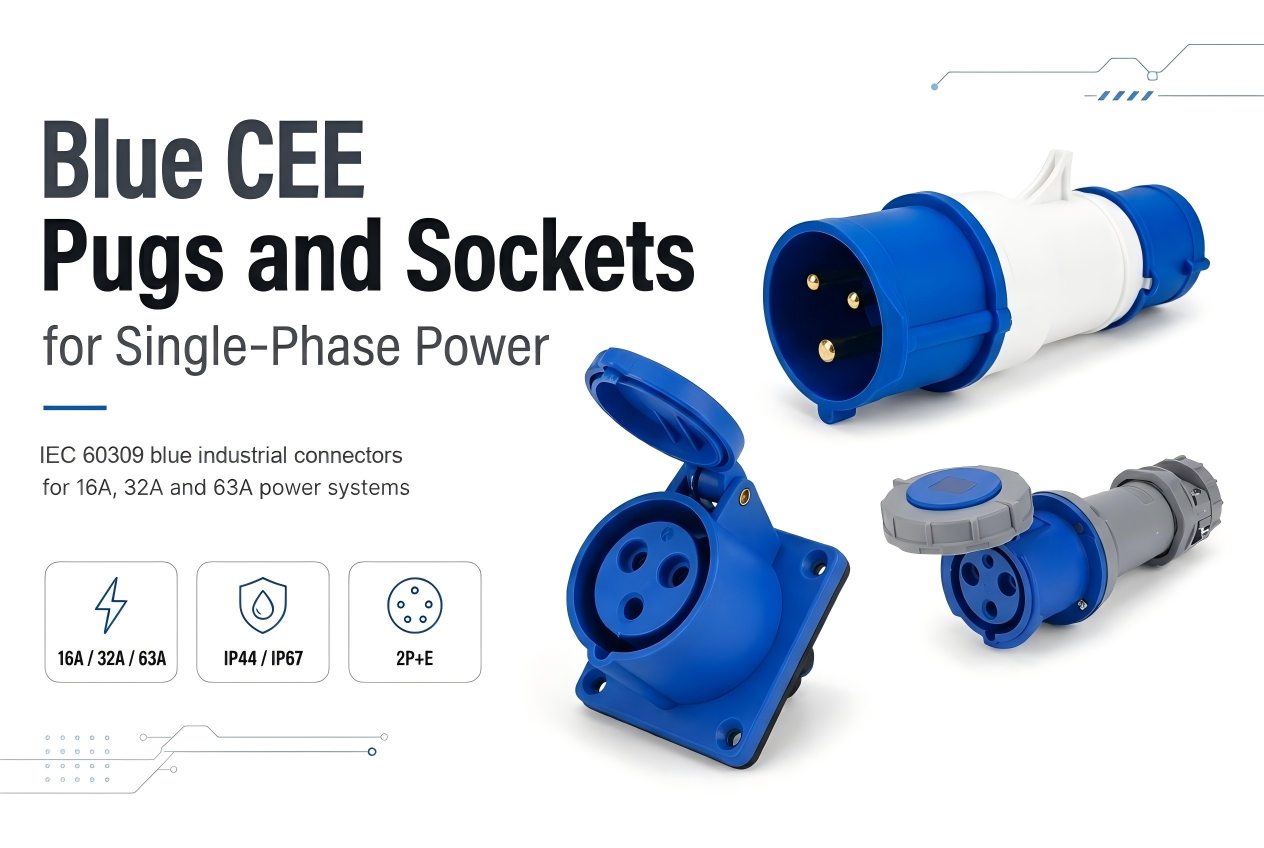
A Schuko, Blue CEE, or Red CEE plug goes into the wall socket; the portable charging unit controls the session and communicates with the car. Schuko is the round household plug used across much of mainland Europe. Blue and Red CEE belong to the IEC 60309 family of industrial connectors, also called Commando plugs — Blue CEE commonly uses 230 V single-phase power, Red CEE commonly 400 V three-phase, and both come in different current ratings.
A note for UK readers: a standard UK three-pin household socket uses a BS 1363 plug, not a Schuko. Some UK locations also have Blue or Red CEE sockets. Match your charger to the socket actually installed.
How Can You Identify the Socket You Have?
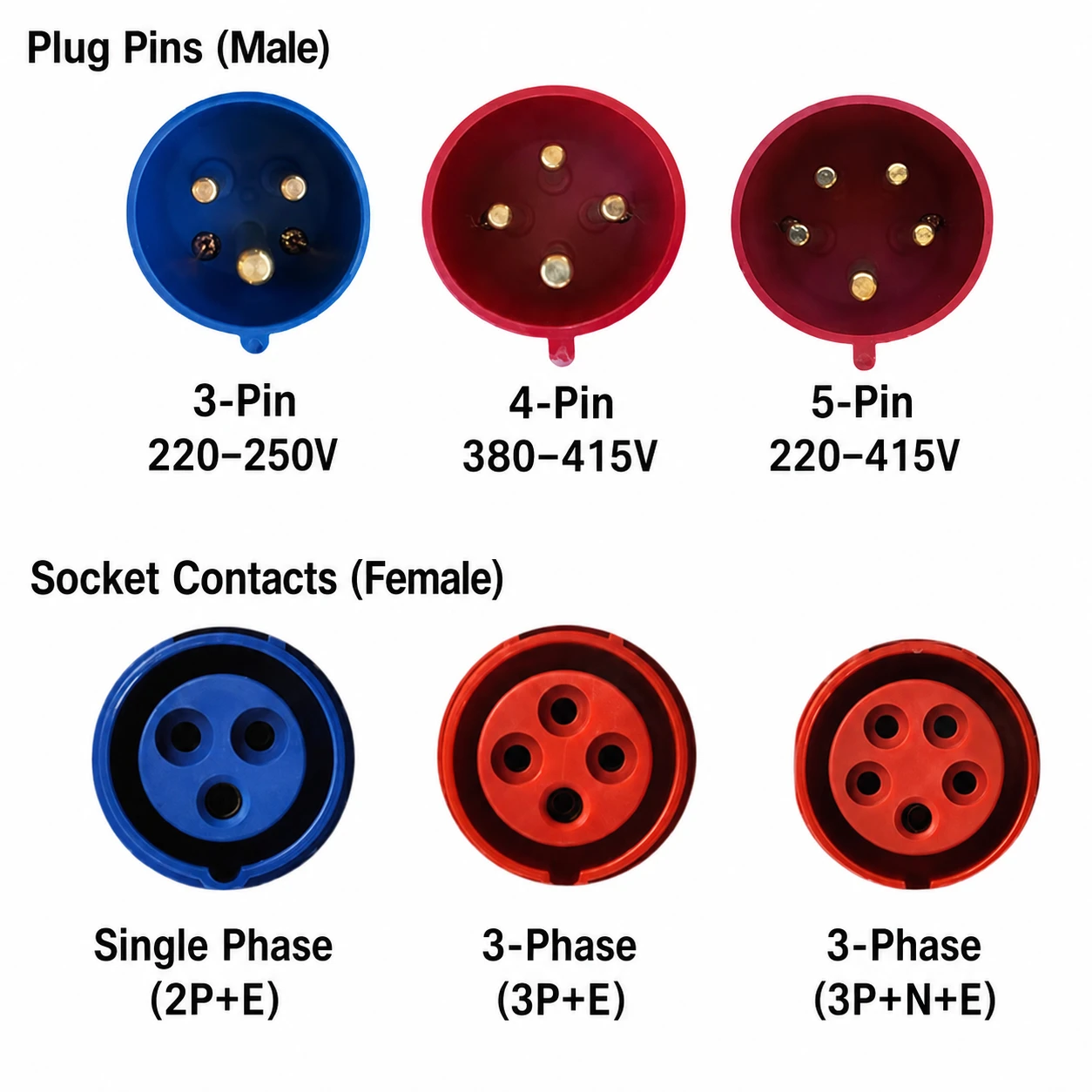
Read the markings on the socket before choosing a plug: voltage, current rating, and pin arrangement — then have a qualified electrician check the circuit if you do not know how it was installed. A Schuko outlet has two round contact openings and side earth contacts; a typical Blue CEE socket has three (live, neutral, earth); a typical Red CEE socket has five (three phases, neutral, earth). Other industrial CEE designs exist, so count the pins and read the label rather than relying on colour alone.
The markings also tell you whether you have a 16 A or 32 A version — they are different connections, and neither should be forced or adapted with an unapproved converter. And an outdoor cover does not prove the circuit is suitable for EV charging; ask an electrician to check its supply, earthing, protection, and condition first.
How Much Charging Power Will You Actually Get?
Your real AC charging power is limited by the lowest-rated part of the setup: the supply, circuit, socket, plug, charging unit, cable, or the car's onboard AC charger. Product labels describe what a unit can deliver under suitable conditions — not what your wall will provide. Single-phase power is roughly voltage multiplied by current (230 V × 16 A ≈ 3.7 kW; 32 A ≈ 7.4 kW), while three-phase gives about 11 kW at 16 A per phase and 22 kW at 32 A.
Three examples show how the chain works. An 11 kW charger on a Blue CEE 16 A socket delivers only about 3.7 kW, because that socket supplies one phase. A 22 kW charger on a Red CEE 16 A socket must limit itself to about 11 kW — and even on a Red CEE 32 A socket, a car with an 11 kW onboard AC charger still charges at no more than 11 kW. And a single-phase-only car cannot use all three phases just because the socket has them. Charging losses and the car's controls reduce the energy that reaches the battery further, so check your vehicle's specifications for a realistic estimate.
Is Schuko Safe for Regular EV Charging?
A standard Schuko socket is best treated as an occasional charging option unless an electrician has assessed the full installation for the intended load. EV charging draws steady current for many hours, and loose contacts, worn sockets, and poor wiring can heat up during that time.
Household Schuko charging should be an emergency solution, because those sockets are designed for household use and only rated for limited periods at 16 A. To reduce overheating and fire risk, it recommends limiting the current to 10 A or less from a standard socket at 230 V — roughly 2.3 kW before losses. This is exactly why adjustable current matters. Our 3.6 kW Type 2 portable charger with a Schuko plug offers 6, 8, 10, 13, and 16 A settings — including the cautious 8 A and 10 A steps ADAC recommends — plus a 1–12 hour delay timer for off-peak charging, an IP65-rated body, and a Type B RCD with AC and DC leakage detection. Set the current your installation allows, not the maximum the charger supports.
If you do charge occasionally, stop at once if you notice heat, discolouration, a burning smell, or a loose connection — and never use extension leads, multi-plug strips, or improvised adapters.
In the UK, take the same care with a BS 1363 socket: the IET's guidance on EV charging installations notes that socket-outlets marked for EV charging face extra test requirements compared with ordinary 13 A outlets. For frequent home charging, ask an electrician to assess your supply — a properly installed Blue CEE socket may suit a compatible charger, while a fixed wall charger may be more convenient at a permanent parking space.

Can You Replace a Schuko Socket With Blue CEE?
You can ask an electrician to assess an upgrade, but replacing the socket face alone does not increase the circuit's capacity — the wiring, breaker, protective devices, earthing, and supply must suit the new load. Blue CEE 16 A supports about 3.7 kW at 230 V when designed for it; 32 A can reach about 7.4 kW but may need a different cable run. Ask what continuous current the circuit can safely support, then match the socket and charger to it.
Can One Portable Charger Work With All Three Plugs?
It depends on the charger model. Some portable EV chargers accept manufacturer-approved interchangeable input plugs, but that does not mean every model works with all three socket types — check the exact version and approved plug options before buying. Changing the input plug does not increase the circuit's capacity or your car's AC charging limit, and a generic adapter does not establish that an unsupported combination is safe — one more reason to know what the certification marks on an EV charger actually tell you.
Which Plug Should You Choose for Your Situation?
Start with the socket available where you park, then consider how often you charge and whether you need to take the charger elsewhere. Have an electrician confirm the circuit and permitted charging current before relying on any socket for EV charging.
- Occasional top-up: a Schuko plug may work in much of mainland Europe if you have checked the socket and circuit and set an appropriate current. Expect slow charging. In the UK, choose equipment made for a suitable BS 1363 socket instead.
- Regular charging from one parking space: ask an electrician whether a dedicated Blue CEE socket or a fixed wall charger suits better — the higher-rated plug only helps if the circuit, local rules, charger, and car allow it.
- Three-phase access: a Red CEE plug may suit a compatible charger; a single-phase car may still charge, but it will not draw power from all three phases. Our 11 kW portable three-phase charger with a CEE Red 5-pin plug is built for exactly this setup — 6–16 A adjustable current, a 1–12 hour delay timer, and a Type 2 connector compatible with Type 2 and CCS2 AC charging.
- Several locations: a portable charger with manufacturer-approved plug options helps — check the socket and permitted current at each location. Workplaces, campsites, and shared properties may set their own limits.
FAQ
Can I charge my EV from a normal household Schuko socket?
Occasionally, yes. ADAC advises treating household Schuko charging as an emergency solution and limiting the current to 10 A or less from a standard socket — roughly 2.3 kW before losses.
How fast is Blue CEE 16 A charging?
About 3.7 kW at 230 V single-phase, if the circuit is properly installed. A 32 A setup can theoretically reach 7.4 kW, but the installation, charger, and car must all allow the higher current.
What is the difference between Blue CEE and Red CEE?
Blue CEE is typically 230 V single-phase (three contacts: live, neutral, earth); Red CEE is typically 400 V three-phase (five contacts: three phases, neutral, earth). Both belong to the IEC 60309 industrial connector family and come in different current ratings — always read the socket's label rather than relying on colour alone.
Will a 22 kW charger charge my car at 22 kW from a Red CEE 16 A socket?
No. The socket supplies about 11 kW, so the charger must limit itself to the circuit — and an 11 kW onboard AC charger is the ceiling regardless of the socket.
Does a higher-amp portable charger charge faster from the same socket?
No. A charger rated for more current still charges at whatever the socket, circuit, and car allow — which is why adjustable current (like the 6–16 A settings on both of our portable models) matters more than the headline rating.
Is a Schuko plug the same as a UK plug?
No. UK household sockets use the BS 1363 three-pin plug, which a Schuko plug does not fit. Some UK locations do have Blue or Red CEE sockets — match your charger to the socket actually installed.