

What if your electric car could do more than just get you from A to B? What if it could run a laptop at a campsite, keep the coffee maker going at a tailgate, or keep the fridge running during a blackout?
That's not a future concept — it's a feature already built into many EVs on the road today. It's called V2L, or Vehicle-to-Load, and it's one of the more practical (and often overlooked) capabilities of the modern EV.
This guide breaks down what V2L actually is, how it works, which vehicles support it, and what to know before you rely on it.
What Is V2L, Exactly?
Vehicle-to-Load is a feature that lets your EV discharge power from its high-voltage traction battery to run external AC devices — essentially turning your car's battery pack into a giant, portable power bank.
Most V2L systems output somewhere between 2.3kW and 3.6kW, roughly comparable to a standard household 3-pin outlet or a 16A commando socket. That's enough to run laptops, lights, small TVs, kettles, and in some cases even power tools.
It's worth noting this is a completely different league from the old 12V cigarette lighter socket in a gas car, which barely handles a phone charger. V2L taps directly into the vehicle's main battery pack, not a small 12V accessory battery.
How Does V2L Actually Work?
Getting power out of the car typically happens one of two ways:
- Built-in interior sockets — Some EVs, like the Hyundai IONIQ 5 or Kia EV6, simply have a household-style outlet built into the cabin or trunk. You plug in and go.
- A V2L adapter at the charge port — More commonly, a dedicated adapter plugs into the same port you use to charge the car, turning it into a power outlet. The vehicle's onboard converter handles the DC-to-AC conversion and power management internally — the adapter itself just handles the physical connection and load.
![[V2L-BY] vehicle-to-load (V2L) adapter for BYD electric vehicles ...](https://q3.itc.cn/q_70/images03/20240824/409e62df78d24abd8a6c360e6134910a.jpeg)
V2L vs. V2H vs. V2G: Don't Mix Them Up
These three terms get lumped together, but they represent very different levels of technology:
- V2L (Vehicle-to-Load): The simplest form — one-way power out, straight to a device. Just plug in an adapter and go, no home rewiring required.
- V2H (Vehicle-to-Home): A step up. This lets your EV power your entire house, typically during an outage. It requires a dedicated bidirectional home charger and a professionally installed automatic transfer switch.
- V2G (Vehicle-to-Grid): The most complex. Your EV can not only power your home but potentially send electricity back to the utility grid, helping balance demand during peak hours. This relies on a bidirectional charger that communicates directly with the grid.
In short: V2L is the feature you can use right now. V2H and V2G are more about the future of home energy management and grid infrastructure.
Which EVs Support V2L?
Not every electric vehicle comes with V2L (Vehicle-to-Load) functionality. In addition to the vehicle itself supporting V2L, some Type 2 vehicles require a specific identification resistor (Resistor) inside the V2L adapter before the vehicle can recognize the adapter and activate power discharge.
Therefore, when buying a Type 2 V2L Adapter, you should not only check whether your vehicle uses a Type 2 charging port. You also need to confirm the vehicle model, model year, and required resistor specification.
Based on commonly used Type 2 V2L configurations, the following resistor specifications correspond to these vehicle models:
| Resistor Specification | Compatible Vehicle Models |
|---|---|
| 2kΩ / 2.7kΩ | MG models (excluding older MG4, MG5 and MG ZS); BYD models; XPeng P5, P7 and other models (excluding G6 / X9); Geely EM-i, EX5; Smart; GWM Cannon Alpha PHEV; Haval Jolion PHEV; Haval H6 PHEV; Zeekr 7X |
| 470Ω | MG ZS, MG4 and MG5 models from 2021–2023; some older Hyundai models |
| 62Ω | Mazda EZ-6 from 2023 onward; some Kia and Hyundai models |
| 4kΩ | XPeng G6 and X9 |
| 75Ω | Chery Tiggo 7 Super Hybrid, Tiggo 8 PHEV and Tiggo 9 PHEV |
Important: V2L compatibility may vary depending on the vehicle model year, market, and trim level. The resistor values above are provided for V2L adapter compatibility reference only. Always confirm the required specification for your specific vehicle before purchasing a V2L adapter.
If your EV supports V2L but does not come with a V2L adapter, we recommend using a compatible and properly rated adapter designed for your vehicle's charging interface. Using an incompatible adapter or an adapter with an unsuitable power rating may prevent V2L from working correctly and could create safety risks.
If your EV uses a Type 2 charging port and you are looking for a reliable V2L solution, check out our EVPEIWE Type 2 V2L Adapter. It is designed for Type 2 vehicles and allows the charging port to be used as an external power outlet for compatible electrical devices.
What Can You Actually Do With V2L?
Camping & Tailgating
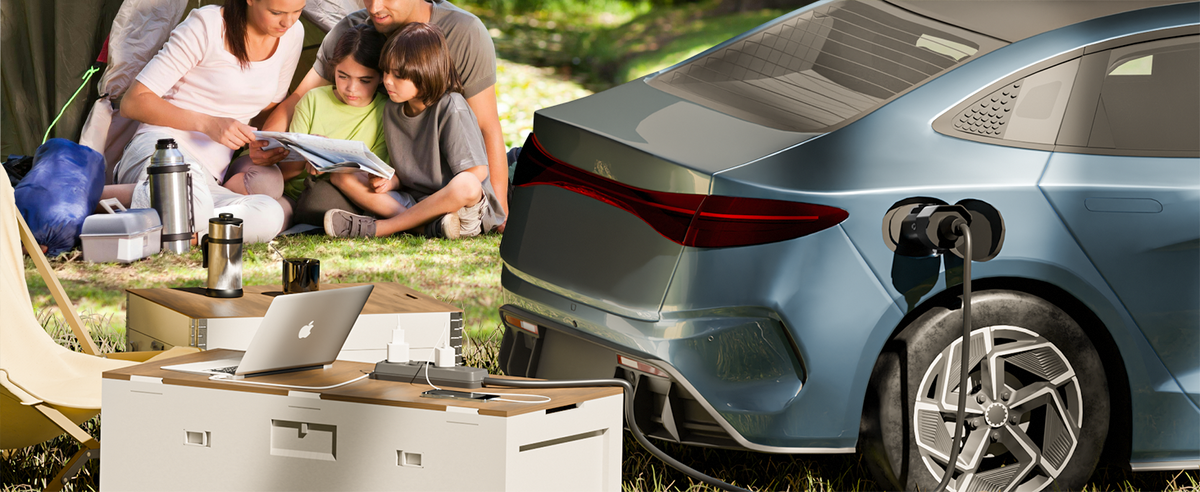
This is where V2L really shines. Instead of hauling a noisy, fume-heavy gas generator, you can quietly run a cooler, a projector for movie night, a kettle for morning coffee, or a portable speaker — straight off the car.
Emergency Backup Power
During a power outage, V2L can keep the essentials running: your fridge, your internet router, a few lights, phone charging. It's not a whole-house solution like V2H, but it's a genuinely useful buffer — keeping a fridge full of food from spoiling alone makes it worthwhile.
Jump-Starting Another EV
A slightly unusual but real use case: if a friend's EV runs out of charge, V2L can transfer just enough power to get them to the nearest charging station. Think of it as the EV version of a jump start.

Remote / Mobile Work
Pull up somewhere scenic, plug in a laptop and a mobile hotspot, and you've got a mobile office — no coffee shop required.
What to Know Before Relying on V2L
- Check the actual output rating. Output ranges from around 2.2kW to 9.6kW depending on the vehicle, so don't assume "V2L support" means the same thing across every model — check the specific trim's rated output.
- Confirm whether the adapter is included. On some models — the Hyundai IONIQ 5, for example — the V2L adapter is only standard on the top trim and costs extra elsewhere. Worth confirming before you buy the car if V2L matters to you.
- Set a discharge limit. Most V2L-capable EVs let you set a minimum battery percentage (typically between 20–80%) through the infotainment screen, so the system automatically cuts power once the battery hits that threshold. Always set this — it's the difference between running an appliance and getting stranded.
- V2L is not a whole-house solution. For full-home backup during an outage, you need V2H, which requires a dedicated bidirectional charger and a properly installed transfer switch. Never attempt to back-feed a home's electrical panel yourself — it's dangerous, can damage your vehicle or home wiring, and can put utility workers at serious risk. Any whole-house setup needs a licensed electrician.
- Follow local electrical code. In the U.S., equipment involved in EV power export falls under NEC Article 625, which governs electric vehicle power transfer systems. For a deeper technical breakdown, see EC&M's overview of NEC requirements for EV equipment. Requirements vary by country, so always check local regulations — and use a licensed electrician — before installing anything involving fixed home wiring.
Does V2L Have a Future?
Almost certainly, yes. An EV's battery pack is, functionally, a massive mobile energy storage unit, and V2L is the first practical step toward putting that stored energy to work beyond just driving. Ford has demonstrated this at scale — an F-150 Lightning powered a home in Texas for three days during a grid outage, a V2H-level use case that shows just how much potential is sitting in these battery packs.
As more automakers — including GM and Toyota — announce plans to add V2L to future models, it's likely to shift from a nice-to-have feature to one of the reasons people choose a particular EV in the first place. The U.S. Department of Energy's Alternative Fuels Data Center continues to track EV charging infrastructure trends, with bidirectional charging increasingly part of that conversation.

Frequently Asked Questions
Can I use V2L while driving?
In almost all current EVs, no — the onboard converter disables external power discharge once the car is put into gear, for safety reasons. A small number of vehicles (like the Ford F-150 Lightning's Pro Power Onboard) allow it while driving, but that's the exception, not the rule.
What's the difference between V2L and V2H?
V2L is designed for portability — a simple adapter powers individual devices directly from the charge port, typically 2.3–3.6kW. V2H is designed for whole-home backup, requiring a dedicated bidirectional charger and a transfer switch installed by an electrician, and can power an entire house during an outage.
What if the adapter or cable gets stuck in the charge port?
Don't force it. A quick double-press of the unlock button on your key fob will usually release the locking pin and let you remove it normally.