

If you've been putting off installing a home EV charger while you waited for the right moment, that moment has technically passed. The federal EV charger tax credit expired after June 30, 2026, and EV owners across the country are now recalculating whether home charging still makes financial sense. With gas prices hovering around $3.80 per gallon and residential electricity averaging 18.8 cents per kWh, the math has changed — but not necessarily in the direction you'd expect.
What Happened to the Federal EV Charger Tax Credit in 2026?
The credit in question is Section 30C, formally known as the Alternative Fuel Vehicle Refueling Property Credit. For years, it let individuals claim 30% of the cost of purchasing and installing qualified EV charging equipment at their primary residence, up to $1,000, provided the property was installed in an eligible census tract.
That window closed for any equipment placed in service after June 30, 2026. If your charger was installed and running before that date, you can still claim it on your tax return using Form 8911. But if you're only now shopping for a home charging setup, the tax credit is no longer part of the equation.
This matters because the EV charger tax credit expired at a moment when EV adoption is still climbing, meaning more owners than ever are facing this decision without the subsidy that made earlier adopters' installations meaningfully cheaper.
Is Home EV Charging Still Worth It Without the Tax Credit?
Losing a $1,000 credit stings, but it doesn't erase the underlying economics of charging at home versus charging in public.
Public charging still carries real downsides:
- Fast-charging rates can run well above home electricity costs, especially during peak hours
- You're often waiting for an available stall, particularly during evenings and holidays
- Sessions require planning your day around a charger's location and availability
Home charging, even without the credit, keeps its core advantages:
- You plug in overnight and wake up to a full battery, with zero waiting
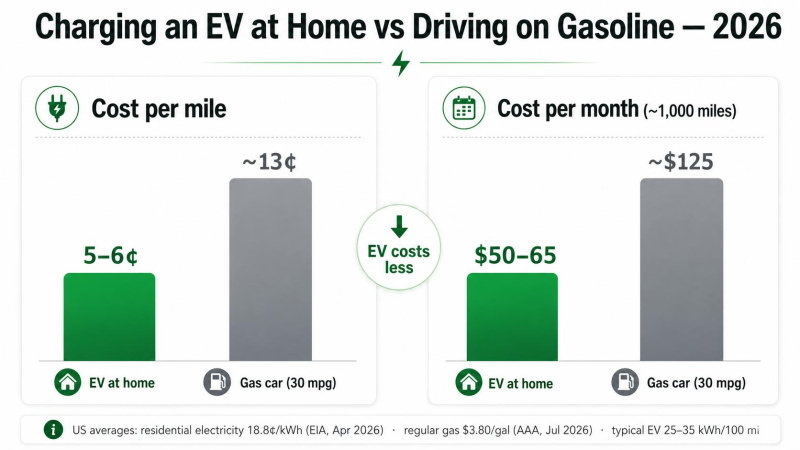
- At roughly 18.8 cents per kWh nationally, home charging is still dramatically cheaper per mile than a $3.80/gallon fill-up at the pump
- There's no detour, no queue, and no dependence on a third-party network being online
In short, the tax credit changed the upfront cost of setup — it never changed the ongoing cost advantage of charging where you park. For most owners, home charging is still the cheaper, more convenient option; the expired credit just means the payback period on your equipment is a little longer than it would have been in 2025.
How EV Owners Can Reduce Charging Costs in 2026
Without a federal incentive to offset installation costs, the smartest move is to control the variables you still have influence over.
- Charge during off-peak hours. Many utilities offer time-of-use electricity rates that are significantly cheaper overnight. Shifting your charging window can meaningfully cut your monthly electric bill.
- Choose the right charger for your actual needs. Not every driver needs a high-amperage, permanently wired Level 2 system. Matching your charger's output to your daily mileage avoids overspending on hardware you won't fully use.
- Avoid unnecessary installation expenses. Panel upgrades, long conduit runs, and permit fees can add thousands of dollars to a hardwired install. Before committing to that route, it's worth confirming your home's electrical setup actually requires it — for many owners, it doesn't.
Portable EV Chargers: A Flexible Alternative for Many EV Drivers
For owners who don't want to commit to a permanent wall-mounted installation — especially now that there's no tax credit to offset the labor and electrical work — a portable Level 2 EV charger is worth a closer look.
A portable charger plugs into an existing 240V outlet, such as a NEMA 14-50 or dryer-style outlet, without requiring an electrician or permanent wall hardware. That makes it useful in a few common situations:
- Garages and driveways with an existing outlet but no dedicated wall charger
- Travel and road trips, where a compatible outlet at a relative's house or campground can double as a charging stop
- RV parks, which frequently have the same 240V outlets used for RV hookups
- Backup charging, in case your primary charging option is temporarily unavailable
Because it isn't a fixed installation, a portable charger also sidesteps most of the panel-upgrade and permitting costs that made hardwired installs more expensive to begin with — which matters more than ever with the tax credit off the table. Brands such as EVPEIWE offer portable EV chargers and adapters designed for exactly this kind of flexibility, covering common connector types including J1772, Type 2, and NACS.
What Should EV Owners Do After the EV Charger Tax Credit Ends?
The end of the federal incentive doesn't change whether home charging makes sense — it changes how you should approach getting there.
- Evaluate your actual charging habits. How many miles do you drive daily, and how often do you realistically need a full charge overnight?
- Compare your charging options honestly. Weigh a permanent Level 2 install against a portable charger against continued reliance on public charging, factoring in both upfront and ongoing costs.
- Choose the setup that matches your situation, not the one that made sense under the old incentive structure. For renters, apartment dwellers, and anyone hesitant about a big upfront electrical project, a portable charger often closes the gap the tax credit used to cover.
The EV charger tax credit expired, but the case for charging at home — quietly, overnight, at a fraction of gas station prices — hasn't gone anywhere.
FAQ
Q1: Is the EV charger tax credit still available in 2026?
No. The federal Alternative Fuel Vehicle Refueling Property Credit (Section 30C) expired for any equipment placed in service after June 30, 2026. If your charger was installed and running before that date, you may still be able to claim it using Form 8911 on your tax return. New installations after the deadline are no longer eligible for this federal incentive.
Q2: How much does it cost to install a home EV charger?
Costs vary widely depending on your electrical panel, the distance from panel to parking spot, and local labor rates. A straightforward hardwired Level 2 install typically runs from several hundred to a few thousand dollars, with panel upgrades adding significantly more. A portable charger avoids most installation labor entirely, since it plugs into an existing outlet.
Q3: Are portable EV chargers worth it?
For many drivers, yes. Portable Level 2 chargers plug into an existing 240V outlet with no electrician required, making them a lower-cost, flexible option — especially now that the tax credit no longer offsets installation expenses. They're particularly useful for renters, frequent travelers, and anyone who wants a backup charging option.
Q4: Can I charge my EV without a permanent wall charger?
Yes. A portable EV charger lets you charge from a standard 240V outlet, such as a NEMA 14-50, without any permanent wiring or wall-mounted equipment. It won't match the fastest hardwired Level 2 units, but it comfortably covers overnight charging for most daily driving needs.