

Every EV driver knows the feeling: the range display hits zero and the next charger is still a few kilometres away. Whether you make it depends less on your nerve than on how the manufacturer calibrated its battery buffer — and the spread, according to a new European group test, is enormous.
In AUTOBEST's 2026 ECOBEST Challenge, journalists drove 15 production EVs until they physically stopped, as InsideEVs reports. All 15 kept moving after the dashboard showed empty, averaging 16 km (10 miles) of additional range. But the outliers tell the real story: the Leapmotor B10 covered 32 km past zero, the Tesla Model Y Long Range 31 km — while the Xpeng P7+ managed 1 km.
How the Test Was Run
The methodology matters, because it explains why this isn't a spec-sheet comparison:
- 15 production-spec EVs driven in convoy near Milan, Italy, on a mix of city streets, country roads and highways
- A lead car set the pace; drivers swapped cars every 30 km to neutralise driving-style differences
- Standard (not Eco) drive mode, climate control on, tyres at recommended pressures, driver only
- Ambient temperatures of 20–25°C — favourable conditions for EVs
- Final phase at Quattroruote's Vairano proving ground: once a car showed either 0% charge or 0 km range, the driver continued until the car could no longer move
A Zeekr 7GT acted as the support vehicle, using its vehicle-to-load (V2L) output to revive stranded cars — a neat demonstration of bidirectional charging as roadside assistance, and a hint at where V2L is heading.
The Results
|
Model |
Distance driven after "empty" |
|
Leapmotor B10 |
~32 km |
|
Tesla Model Y Long Range |
~31 km |
|
Average, all 15 EVs |
~16 km |
|
Xpeng P7+ |
~1 km |
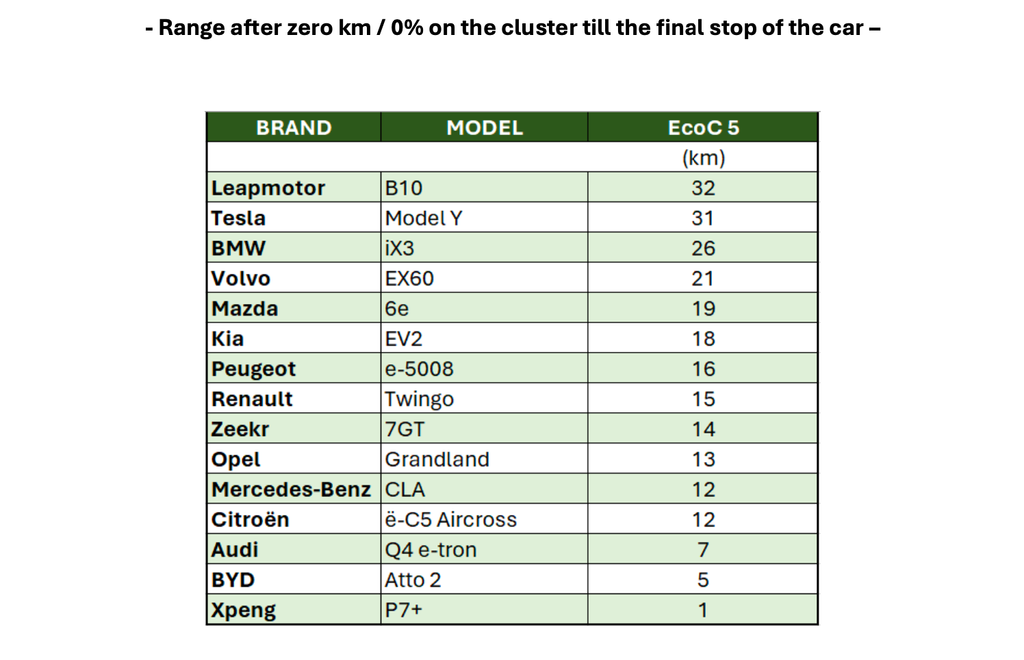
That's a 32-fold spread between best and worst. Note the caveat: the P7+ is a China-market model, not the XPeng P7 sold in Europe, so the result doesn't transfer directly to European variants. XPeng's broader product direction is a different story — our coverage of the XPeng G9L's Australian launch looks at how the brand is positioning its newer models on range and charging.
Why an EV Still Moves at 0%
A displayed 0% does not mean the battery is physically empty. Three things are happening:
1. The buffer. The battery management system makes only part of the pack's total energy available for driving. Below the displayed 0%, a small usable reserve often remains — the size of which is a manufacturer decision.
2. The protected floor. As state of charge falls, cell voltage drops. Before it reaches a level that damages the cells, the car reduces power and eventually disconnects the drivetrain. So even a "dead" EV still holds energy it will not let you use.
3. Two different estimates. State of charge is the BMS's assessment of remaining usable energy. Remaining range is a forecast of how far that energy will stretch, factoring in recent consumption, speed and conditions. They don't have to hit zero together — which is why a car can show 0% and still display a few kilometres of range, or show 0 km with 1% left.
What the Test Can't Tell You
The results table doesn't report how much energy remained at the empty threshold, or the speed each car held afterwards. So a car that drove 32 times farther than another did not necessarily have 32 times the reserve — it may simply have been more efficient at that moment, or maintained a lower speed.
There's also a starting-point inconsistency: some cars hit 0% first, others hit 0 km first. That makes the test realistic, but not a controlled technical comparison. Treat it as evidence that buffers vary wildly — not as a ranking of battery quality.
What to Do When You Hit Single Digits
The reserve is unpredictable. Your behaviour doesn't have to be:
- Treat single digits as a stop signal. Start looking for charging at 10%, not at 0%.
- Slow down immediately. Aerodynamic drag rises steeply with speed; dropping from highway pace to 80 km/h can add meaningful kilometres, especially in Australia where chargers can be 100 km apart.
- Cut the auxiliary load. Heating and air conditioning draw directly from the pack — on a hot Australian day, that's a real number.
- Don't count on the buffer. Cold weather, headwinds, hills and higher speeds all shrink it; the 16 km average was measured at 20–25°C on flat-ish roads. FuelEconomy.gov documents how much cold and speed alone can move real-world EV efficiency.
- Know your car's behaviour before you need it. One careful low-charge run in safe conditions tells you more than any published table.
And if you do run flat, V2L — as demonstrated by the support vehicle — is increasingly the difference between a 20-minute top-up and a tow truck.
The Bottom Line
All 15 EVs kept going past empty, but the range from "0%" to "stopped" varied from 1 km to 32 km under identical conditions. That's not a safety margin you can plan around; it's a lottery ticket with better odds for some models.
The number worth remembering isn't the 16 km average. It's that the average is made of 1 km and 32 km — and you don't get to choose which one your car is on the day.
FAQ
How far can an EV go after showing 0%?
In AUTOBEST's 2026 test of 15 EVs, all continued past empty and averaged about 16 km. Results ranged from roughly 1 km (Xpeng P7+) to 32 km (Leapmotor B10), with the Tesla Model Y Long Range at about 31 km.
Why does an EV still drive at 0%?
Because 0% refers to the usable energy the battery management system makes available, not the pack's physical content. A small reserve remains below the displayed zero, plus a protected floor the car won't release to prevent cell damage.
Can I rely on the reserve when planning a trip?
No. The reserve varies enormously between models and shrinks with cold, speed, hills and headwinds. Treat a single-digit state of charge as a signal to charge, not as a guaranteed distance.
Do 0% charge and 0 km range happen at the same time?
Not necessarily. Charge percentage reflects estimated usable energy; range is a forecast based on recent consumption and conditions. One can reach zero before the other.
Does driving an EV to 0% damage the battery?
The vehicle's protection systems cut power before deep discharge can damage the cells, so an occasional low-charge event isn't catastrophic. Habitual deep discharge still stresses the pack, and heat accelerates the effect in Australian conditions.