

Rivian has spent years as the EV industry's most admired money-loser: brilliant products, brutal burn rate. Its third-quarter 2026 earnings report suggests that story may finally be turning — and the reason is a vehicle that didn't exist a year ago.
Just months after deliveries began, the Rivian R2 is already the company's best-selling model, outselling the R1T, R1S and its electric delivery van combined between July and September. Rivian delivered a record 19,751 vehicles in Q3, and on Thursday it raised its annual delivery guidance again — from 65,000–70,000 units to 67,000–70,000.
Here's what the numbers say, why the R2 matters far beyond Rivian, and what it signals about the affordable EV market.
The Numbers: A Record Quarter With a Caveat
Rivian's Q3 results, reported by InsideEVs, tell a story of scale arriving faster than expected:
|
Metric |
Q3 2026 |
Change |
|
Deliveries |
19,751 |
Record quarter |
|
Revenue |
$2.1 billion |
+38% year over year |
|
Net loss |
$913 million |
Improved from $1.17 billion |
|
Software & services revenue |
$605 million |
+45% (VW partnership) |
|
Full-year guidance |
67,000–70,000 |
Raised twice this year |
To hit even the low end of that guidance, Rivian needs to deliver at least 25,193 vehicles in Q4 — which would be its best quarter ever. Interim CFO Derek Mulvey said the company expects the majority of those to be R2s. Rivian has already added a second production shift for the R2 and expects its run rate to climb through the coming quarters.
The caveat is obvious: Rivian still isn't profitable. A $913 million quarterly loss is an improvement, not a solution. But the company says it expects the R2 ramp to help it end the year with a positive automotive gross margin — the milestone that separates a promising startup from a viable automaker.
Why the R2 Is Make-or-Break
Let's be clear about what's at stake. The R2 is the vehicle designed to take Rivian from a niche purveyor of $90,000 adventure trucks to a genuine volume automaker competing directly with the Tesla Model Y — the world's best-selling EV.
CEO RJ Scaringe framed it plainly: "We had great results with R2 becoming our best selling vehicle by volume in the third quarter. Customer and media feedback on R2 has been exceptional."
The strategic logic runs deeper than one model. R2 volume is meant to fund:
- Development of future models (R3, R4)
- Rivian's autonomy program
- The company's path to profitability
That's the classic startup flywheel — but it only spins if the volume materialises. So far, it is.
The Pricing Ladder Is the Real Story
For all the talk of autonomy and robotaxis, the most consequential detail in Rivian's R2 strategy is its pricing ladder:
- Performance Launch Edition: just under $60,000 (launched June 2026)
- Premium: $53,990 (arriving this year)
- Standard: $44,990 (joining the lineup in 2027)
That last figure is the one to watch. A $44,990 midsize electric SUV from a well-regarded American brand lands squarely in the heart of the mainstream market — the price band where most buyers actually shop and where EV options have been thinnest.
It's the same story playing out across the U.S. market, where affordable EVs are finally arriving in meaningful numbers. We tracked a similar shift when Ford's Fathom redefined what an affordable electric pickup looks like, and the broader context — an industry recalibrating after a turbulent stretch — is covered in our analysis of the U.S. EV industry's adjustment period. The pattern is consistent: the next phase of EV adoption won't be won by flagship halo cars, but by competent vehicles at prices normal people can finance.
The VW Partnership: Helping and Complicating
One of Rivian's quiet advantages is its partnership with Volkswagen Group, which has helped drive software and services revenue up 45% to $605 million. Rivian's software stack — developed for its own vehicles — is being licensed into VW's future platforms, turning a cost centre into a revenue line.
That arrangement has its skeptics, and for good reason: VW has been deepening its ties with XPeng in China, and industry watchers have questioned how durable the Rivian relationship is once VW's own software organisation matures. For now, though, the partnership is a genuine financial cushion — and a validation that Rivian's electrical architecture and software are competitive at a global scale.
Autonomy and Robotaxis: The Next Bet
Rivian isn't content to be just a carmaker. Its Autonomy+ offering currently provides hands-free highway driving and on-command lane changes, with a more advanced version adding point-to-point autonomous driving on city streets — a limited rollout is expected before the end of this year, rivalling Tesla's Full Self-Driving (Supervised).
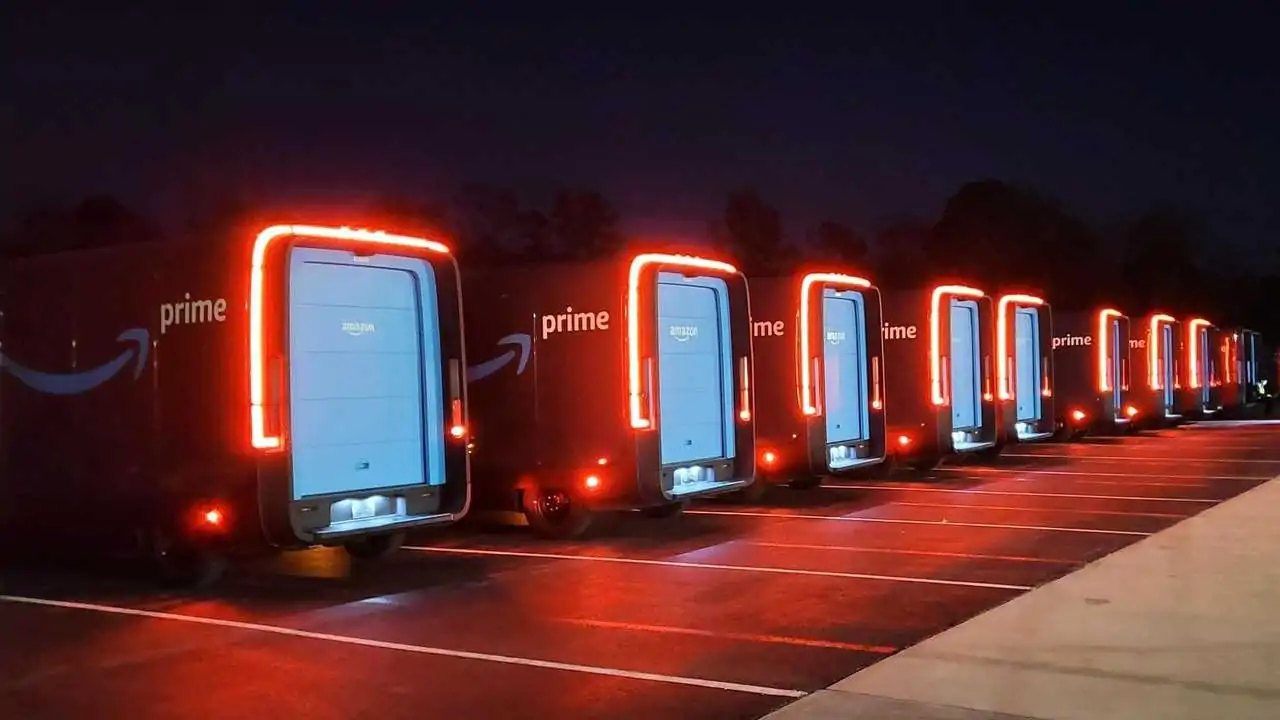
Separately, Rivian plans to deliver up to 50,000 robotaxis to Uber starting in 2028, and recently acquired U.K.-based synthetic data startup Third Dimension to support those efforts. It's an ambitious second act for a company still working toward gross-margin profitability — and a reminder that in this industry, the vehicle business and the software business are increasingly inseparable.
What This Means for EV Buyers
Three practical implications for anyone shopping in this segment:
- The $45,000 EV is finally real. With the R2 Standard arriving in 2027, the mainstream electric SUV segment is getting a credible American entry — alongside the Model Y and a wave of Chinese-engineered competitors.
- Competition is compressing prices. Rivian's ramp, Ford's affordable Fathom, and incoming budget models all point the same direction: better EVs, lower prices, more choice. For buyers, waiting a year increasingly pays.
- Charging standards matter more than ever. The R2 uses NACS in North America, meaning it can access Tesla's Supercharger network directly — but older EVs and mixed-standard households still need adapters and extension solutions. Our NACS extension cord FAQ for 2026 covers compatibility for portable chargers, and our explainer on dual-voltage portable chargers is worth reading if you're planning home charging for a new EV.
The Bottom Line
Rivian's R2 becoming the company's best-seller within months is the strongest signal yet that affordable electric SUVs can find genuine volume demand in the U.S. — not as compliance cars or loss leaders, but as the main event. The company still has to prove it can make money doing it, and 2027's $44,990 Standard model will be the real test. But for the first time in years, Rivian's story is about demand rather than survival.
Frequently Asked Questions
Is the Rivian R2 Rivian's best-selling vehicle?
Yes. In Q3 2026, the R2 outsold the R1T, R1S and Rivian's electric delivery van combined, becoming the brand's highest-volume model just months after deliveries began.
How much does the Rivian R2 cost?
The Performance Launch Edition launched at just under $60,000, a Premium model at $53,990 arrives this year, and a Standard version at $44,990 joins the lineup in 2027.
Is Rivian profitable yet?
No. Rivian reported a net loss of $913 million in Q3 2026 — an improvement on the $1.17 billion loss a year earlier — but expects the R2 ramp to help it achieve positive automotive gross margin by year-end.
What charging standard does the Rivian R2 use?
The R2 uses NACS (Tesla's connector standard) in North America, giving it direct access to Tesla's Supercharger network.