

If you just switched to a NACS-equipped EV — a Tesla, or a Ford, GM, Rivian, Hyundai, or another 2025-and-later model built with the North American Charging Standard port — you've probably noticed that most of the country's charging network still isn't NACS. J1772 Level 2 chargers sit in parking garages, hotels, and workplaces everywhere, and CCS DC fast chargers are still the majority of public fast-charging stalls. To use either one, you need an adapter. But not just any adapter — you need the right kind, because AC and DC adapters for NACS are built for completely different jobs and are not interchangeable.
Why NACS Needs Two Different Adapters
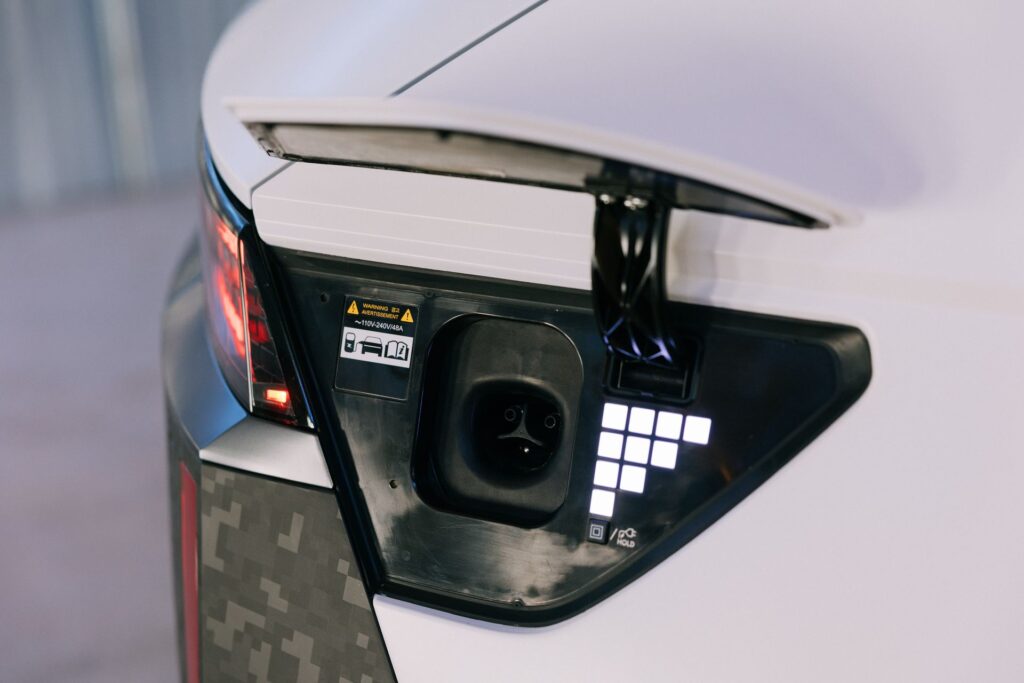
Here's the part that trips up most new NACS owners: the NACS port is unusual because it uses the same physical pins to carry both AC and DC power. Older standards like CCS bolt separate DC pins onto a J1772-style AC base, which is why a CCS plug looks bulky with two extra prongs. NACS does it all through one compact 5-pin connector.
That efficiency is great for automakers, but it means an adapter has to be engineered for one type of power flow — AC or DC — not both. According to the Joint Office of Energy and Transportation, the NACS connector standard (now formalized as SAE J3400) supports AC Level 1/Level 2 charging and DC fast charging through the same pin layout, but the electronics inside an adapter still have to be purpose-built for the current type it's converting. That's why you'll never find one universal adapter that handles both a Level 2 charger and a 350kW DC fast charger — you need two separate tools.

Adapter #1: J1772 to NACS (AC / Level 2)
This is the adapter you'll use most often. It lets your NACS vehicle plug into any standard J1772 Level 2 charger — the kind found at:
- Apartment and condo charging stations
- Hotels and shopping centers
- Workplace chargers
- Home Level 2 chargers that weren't originally sold with a NACS plug
A J1772-to-NACS adapter is a low-voltage, low-current AC device. It's small, lightweight, and generally inexpensive because it doesn't need to manage the high currents or communication protocols that DC fast charging requires. If your daily charging routine is overnight at home or a few hours at work, this is the adapter that matters most. Our J1772 to NACS EV Charging Adapter is built specifically for this Level 2 use case, rated for up to 80A/240V AC charging.
Adapter #2: CCS to NACS (DC Fast Charging Only)
This is the adapter you need for road trips and quick top-ups. It allows a NACS vehicle to fast-charge at CCS DC stations — the Electrify America, EVgo, and other non-Tesla fast-charging networks still make up a large share of public DC infrastructure across the U.S.
CCS-to-NACS adapters are a different category of product entirely. They have to safely handle high DC voltages (often up to 1,000V) and high currents (150A–250A+), manage active cooling or thermal protection, and correctly relay the CCS communication protocol to the vehicle. This is why DC adapters cost significantly more than AC ones and are engineered to a much stricter safety standard. Our CCS2 to NACS Fast Charging Adapter is rated for 250A/1000V and built for Cybertruck and other 2021+ NACS Tesla models needing DC-only fast charging.
Important: a CCS-to-NACS adapter is DC-only. You cannot use it on a J1772 Level 2 charger, and a J1772-to-NACS adapter cannot be used on a DC fast charger. Mixing them up isn't just ineffective — it's a safety risk, since the internal electronics aren't rated for the other current type.
Quick Comparison
| J1772 to NACS (AC) | CCS to NACS (DC) | |
|---|---|---|
| Use case | Level 2 home/public charging | DC fast charging on road trips |
| Power type | AC only | DC only |
| Typical rating | Up to 48A–80A / 240V | Up to 250A / 1000V |
| Where you'll use it | Home, work, hotels, garages | Highway fast-charging stations |
| Relative cost | Lower | Higher |
Which One Do You Actually Need?
If you mostly charge overnight at home or plug in during the workday, start with a J1772-to-NACS adapter — it covers the vast majority of everyday charging situations. If you take regular road trips and rely on public DC fast-charging networks, a CCS-to-NACS adapter is worth the investment, since Superchargers alone won't always be the most convenient stop along your route.
Many NACS owners end up owning both, since they solve two entirely different problems. To browse the full range of compatible options — including adapters for other connector types like GB/T and Type 1 — check out our EV Adapters collection. And if you're still getting familiar with how all the North American charging standards fit together, our guide to EV Charging Standards: CCS, NACS, J1772, Type 1 & Type 2 breaks it down in more detail.

The Bottom Line
NACS's shared-pin design is elegant for automakers, but it means AC and DC charging each need their own dedicated adapter. Know which one you're buying, check the amperage and voltage rating against your charging needs, and — as always — buy from a source that lists real UL/CE certification, since a poorly built DC adapter carrying hundreds of amps is not the place to cut corners.