

A NEMA 6-20 outlet occupies a useful middle ground in home EV charging. It's a 240-volt connector, so it charges noticeably faster than a standard wall outlet, but it draws less from your electrical panel than a full-size Level 2 setup like NEMA 14-50. For drivers who don't need maximum charging speed but do want a real upgrade over Level 1, it's worth understanding what this outlet can and can't do.
This guide walks through the NEMA 6-20's voltage and amperage, realistic charging speed, how it stacks up against NEMA 5-15 and NEMA 14-50, and the situations where it's the smarter — or wrong — choice.
What Is a NEMA 6-20 Plug?
NEMA 6-20 is a straight-blade plug configuration built for 240V circuits rated at 20 amps. It uses two hot conductors and a ground — there's no neutral wire, which is fine for EV charging since Level 2 chargers pull power line-to-line and don't need a neutral to function.
You'll typically find NEMA 6-20 receptacles in garages, workshops, and small commercial spaces where a mid-size 240V circuit is already in place. Because the receptacle shape differs from a standard household outlet, a regular 120V plug won't fit into it — the two systems aren't interchangeable by accident.
How Much Power Does NEMA 6-20 Deliver?
On paper, a 240V/20A circuit works out to 4.8 kW. In practice, EV charging is a sustained, hours-long load, so it's not run at the full breaker rating. The standard safety margin caps continuous draw at 80% of the circuit's rating — meaning a 20A circuit should generally supply no more than 16A to the charger.
| Spec | Typical Value |
| Outlet type | NEMA 6-20 |
| Nominal voltage | 240V (residential); 208V in some commercial buildings |
| Circuit rating | 20A |
| Recommended continuous charging current | 16A |
| Charging power at 240V | ~3.8 kW |
| Charging power at 208V | ~3.3 kW |
That's well below what a 40–50A home wallbox can deliver, but a clear step up from a standard household outlet. You can learn more about EV charging power basics via the U.S. Department of Energy Alternative Fuels Data Center.
Real-World Charging Speed
Actual mileage gained per hour depends on the vehicle's onboard charger, battery size, charging efficiency, and even outside temperature — but as a rough benchmark, a NEMA 6-20 setup running at 240V/16A tends to add somewhere around 10 to 15 miles of range per hour. Smaller, more efficient EVs may see a bit more; larger SUVs and trucks somewhat less.
For most owners, the more useful question isn't "how long to charge from empty," since few people run their battery all the way down daily. If your overnight need is closer to 30–50 miles, a NEMA 6-20 setup usually keeps up fine. If you're regularly recovering 150+ miles overnight, you'll want a higher-power Level 2 charger instead.
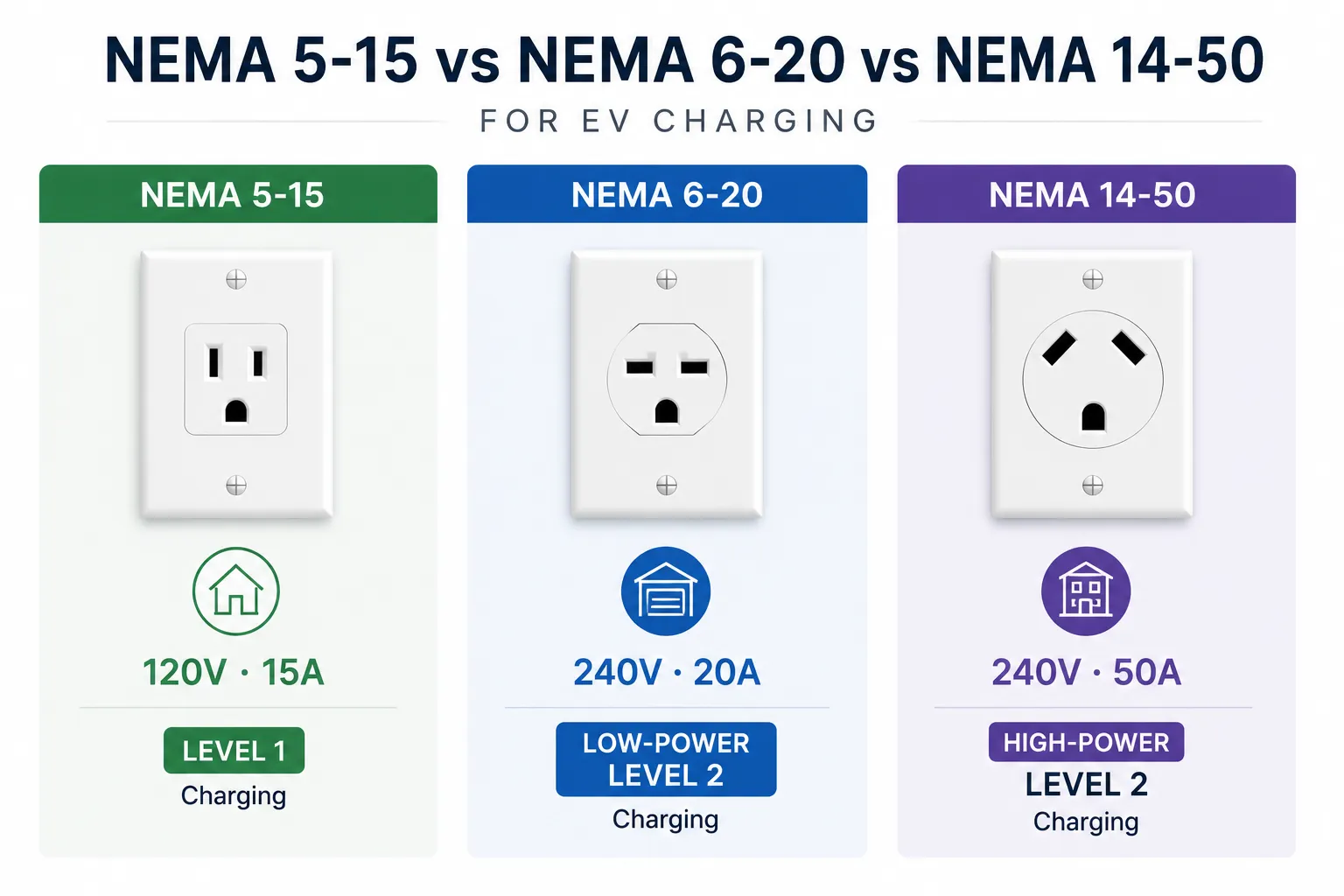
NEMA 6-20 vs. NEMA 5-15 vs. NEMA 14-50
| Comparison | NEMA 5-15 | NEMA 6-20 | NEMA 14-50 |
| Voltage | 120V | 240V | 240V |
| Typical continuous charging current | 12A | 16A | 40A |
| Approximate charging power | ~1.4 kW | ~3.8 kW | ~9.6 kW |
| Charging level | Level 1 | Level 2 (lower power) | Level 2 (higher power) |
| Neutral conductor | N/A | No | Yes |
| Best for | Occasional charging, emergency backup | Moderate daily mileage, limited panel capacity | Frequent drivers, fastest home charging |
If Level 1 charging feels too slow but your panel can't support a 50A circuit, NEMA 6-20 is a practical stepping stone. If your panel has the headroom and you want the fastest home charging available without hardwiring, NEMA 14-50 is generally the better pick.Return to NEMA plug comparison article for full side-by-side analysis.
When Does NEMA 6-20 Make Sense?
NEMA 6-20 fits best when your charging need is real but not extreme:
- Moderate daily mileage. Drivers covering roughly 20–60 miles a day with overnight plug-in access are usually well served.
- Limited electrical capacity. Some homes can't easily support a 40–50A EV circuit without a panel upgrade; a 20A/240V circuit is often a lighter lift — though this always needs to be confirmed by an electrician, not assumed.
- Portable charging setups. For drivers who want a flexible, portable Level 2 charger rather than a fixed wallbox, a properly installed NEMA 6-20 outlet offers a middle-power option.
- Multifamily or apartment parking. Where every parking spot can't realistically get a high-power charger, lower-power Level 2 circuits can serve more vehicles within existing capacity.
- Backup charging. Some owners keep a NEMA 6-20-compatible portable charger as a secondary option alongside a faster primary wallbox.
Installation and Safety Considerations
A 240V outlet is safe when installed correctly — and risky when it isn't. A few non-negotiables:
- Use a dedicated circuit. Sharing the circuit with other loads raises the risk of nuisance trips or overheating.
- Match breaker, wiring, and receptacle ratings. Don't use a NEMA 6-20 receptacle as a workaround for a charger that needs more than 16A continuous — the charger's current setting has to match the circuit, not the other way around.
- Avoid questionable adapters. An adapter that lets a charger pull more current than the outlet is rated for is a real fire risk. Only use adapters explicitly approved by your charger's manufacturer.
- Follow local code. Permit requirements, GFCI rules, and inspection standards vary by location. A licensed electrician can confirm whether NEMA 6-20 is the right call for your space, or whether a hardwired charger makes more sense.
If the plug ever feels warm to the touch, the outlet feels loose, or the breaker trips repeatedly, stop using it and have it inspected before continuing.
Choosing a Charger for a NEMA 6-20 Outlet
Not every EV charger works with this outlet out of the box. When shopping, check for:
- Matching input plug — the charger or an approved adapter needs to be built for NEMA 6-20.
- Correct current limit — it should cap output at 16A on a 20A circuit.
- Vehicle connector compatibility — J1772, NACS/J3400, or an adapter depending on your EV.
- Recognized safety certification — look for testing from an accredited lab.
- Smart charging features — scheduling and power monitoring can help manage cost and avoid overload, especially useful in shared parking settings.
Is NEMA 6-20 Suitable for Commercial Use?
For high-turnover public charging — retail lots, highway stops, fleet depots — NEMA 6-20's output is too low; those sites need higher-power AC or DC fast charging. But for locations where vehicles sit parked for hours at a time, it can still work well: workplace lots, apartment or condo garages, hotels, and light-duty service yards. In these settings, charger durability, access control, and billing usually matter more than raw speed.
Common Mistakes to Avoid
- Picking the outlet before sizing your actual need. Start with your daily mileage, not with whatever outlet happens to be available.
- Assuming all 240V outlets are interchangeable. NEMA 6-20, 6-50, 14-30, and 14-50 all have different ratings and wiring — the plug shape isn't cosmetic.
- Using extension cords. Long charging sessions generate sustained heat; undersized or worn cords are a real hazard.
- Overlooking 208V commercial service. A charger drawing 16A at 208V nets about 3.3 kW instead of 3.8 kW — worth factoring into charging-time estimates.
- Not planning for growth. A NEMA 6-20 setup may cover one EV today, but a household adding a second vehicle, or a business scaling up, may outgrow it faster than expected.
Final Thoughts
NEMA 6-20 hits a practical sweet spot: faster than a standard household outlet, less demanding on your electrical panel than a full Level 2 circuit. At roughly 3.8 kW, it comfortably covers overnight charging for moderate daily driving. Its main trade-off is ceiling — for high-mileage drivers, fleets, or busy commercial lots, a higher-power AC or DC fast charging solution will serve better long-term.
Whatever you choose, the safest path is the same: size the charger to your actual usage, confirm your panel has the capacity, and have a licensed electrician review the installation before you rely on it daily.
Frequently Asked Questions
Can I charge an EV with a NEMA 6-20 outlet?
Yes, with a compatible charger or a manufacturer-approved adapter, installed on a dedicated circuit and reviewed by a licensed electrician.
How many amps can a NEMA 6-20 EV charger draw?
The circuit is rated for 20A, but continuous EV charging should be limited to about 16A.
How many kW does NEMA 6-20 provide?
Roughly 3.8 kW at 240V/16A, or about 3.3 kW at 208V/16A.
Is NEMA 6-20 Level 1 or Level 2?
Level 2 — it runs at 240V, just at lower power than larger circuits like NEMA 14-50.
Is NEMA 6-20 enough for overnight charging?
For moderate daily mileage, generally yes. For very high nightly range needs, a higher-power Level 2 charger is a better fit.
Does NEMA 6-20 have a neutral wire?
No — it uses two hot conductors and a ground only.
Should I choose NEMA 6-20 or NEMA 14-50?
Choose 6-20 if your panel capacity is limited and moderate speed is enough. Choose 14-50 (or a hardwired charger) if you want faster Level 2 charging and your panel can support it.