

BloombergNEF has once again revised its outlook for the US electric vehicle market, and the update is worth paying attention to whether you already own an EV or are still considering one. The research firm's latest projection puts EVs at just 17% of US passenger vehicle sales by 2030 — a meaningful reduction from earlier estimates. For current and prospective EV owners, the natural question is what this actually changes. The answer involves separating short-term market turbulence from the longer-term trajectory of electrification, and understanding how both connect to something very practical: how and where people charge their vehicles.
A Reset in the U.S. EV Market Outlook
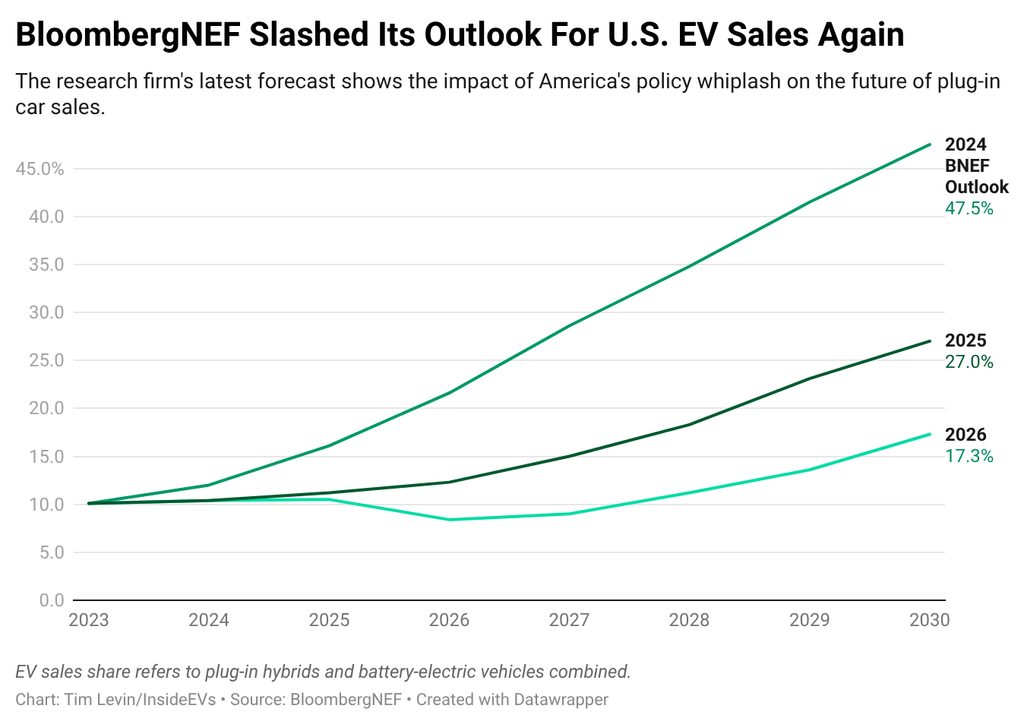
BloombergNEF's Electric Vehicle Outlook has been revised downward for two consecutive years. As recently as 2024, the firm projected that nearly half of new car sales in the US — 47.5% — would be electrified by 2030. That estimate dropped to 27% in last year's report, and now sits at 17% in the most recent outlook.
It's important to note what this forecast measures and what it doesn't. A lower percentage doesn't mean EV sales are shrinking — it means the pace of growth is slower than previously modeled. Total EV sales in the US are still expected to increase through the decade; they're just expected to represent a smaller slice of a market that BNEF now believes will lean more heavily on gasoline and hybrid vehicles than earlier projections assumed.
This kind of forecast recalibration isn't unusual in a fast-moving industry, but the scale of this particular adjustment — cutting the outlook nearly in half in a single year — reflects how sensitive EV adoption is to the policy and cost environment surrounding it.
What Is Driving the Slowdown
Several overlapping factors are behind the downgrade, most of them tied to changes in federal policy and market economics rather than any shift in the underlying technology.
Reduced federal incentives. The $7,500 federal tax credit for new EVs expired for most buyers after September 30, 2025, and is scheduled to end entirely by January 1, 2027. Since the credit had been a significant factor in EV affordability, its removal has directly affected purchase decisions, particularly for buyers comparing an EV to a similarly priced gas vehicle.
Import tariffs. New tariffs — including a 25% tariff on imported vehicles generally and a 100% tariff on Chinese-made EVs — have raised the cost of bringing several EV models into the US market, squeezing margins on vehicles that were originally positioned as affordable options.
Fewer available models. A number of EVs have been paused, delayed, or discontinued in the US over the past two years, including several import-dependent models that became difficult to price competitively once tariffs and tax credit changes took effect. Some automakers have also scaled back domestic EV manufacturing investments, which has reduced near-term model availability even as demand for electrification continues globally.
Regulatory uncertainty. Changes affecting federal fuel-economy standards and state-level emissions authority have added unpredictability for automakers planning multi-year product roadmaps, making some companies more cautious about committing to new EV programs in the near term.
Together, these factors have made the US market meaningfully more difficult to forecast than it was just two years ago.
Why EV Adoption Is Not Reversing Long-Term
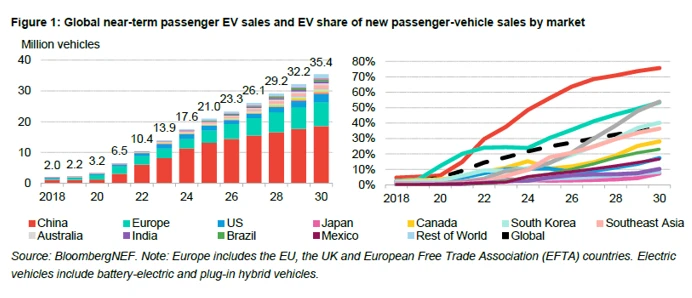
Despite the US-specific slowdown, the global EV trend continues to move in one direction. BloombergNEF still expects global EV sales to reach roughly 23 million vehicles in 2026, up more than 10% from the prior year, with EVs projected to account for around 38% of global car sales by 2030. Markets including China, the UK, and much of Europe continue to outpace the US in EV adoption rates.
Several structural trends support continued long-term growth, regardless of near-term US policy shifts:
- Battery costs continue to decline over time, which has historically been one of the strongest drivers of EV price competitiveness.
- Total cost of ownership remains favorable for many EVs over a multi-year holding period, thanks to lower fuel and maintenance costs compared to gasoline vehicles, even when upfront purchase price is higher.
- Consumer interest in EVs has not disappeared — automakers report that demand softened primarily in categories most affected by tax credit and tariff changes, rather than across the board.
- Global manufacturing scale keeps improving as more automakers standardize EV platforms, which tends to bring costs down over time even in markets facing near-term headwinds.
In short, the US may be growing more slowly than once projected, but the broader shift toward electrification — worldwide and over the long run — remains intact.
What This Means for EV Owners and Charging
For the millions of EVs already on US roads, and the millions more expected by 2030 even under the revised forecast, one thing doesn't change: reliable charging remains central to the ownership experience.
As EV numbers grow, home charging becomes an increasingly important part of daily EV use, since it remains the most convenient and cost-effective way most owners charge. But home charging setups aren't uniform. Garage layouts, the location of electrical panels, and parking distance from an outlet can all affect how practical a given charging setup actually is. A charging cable that works perfectly for one owner's driveway may be too short for someone parking farther from a power source, or dealing with a garage where the panel sits in an inconvenient spot.
This is where practical accessories like an EV extension cable or a properly rated EV charging cable come into play — not as a workaround for a poor setup, but as a way to adapt charging equipment to the realities of different homes. As more owners rely on home charging day to day, understanding these practical considerations becomes as important as understanding the vehicle itself.
Companies like EVPEIWE focus specifically on this layer of the EV ownership experience — practical, reliable accessories that help owners get consistent, safe charging regardless of how their home or parking setup is configured.
Conclusion
The latest BloombergNEF outlook is a reminder that EV adoption in the US is being shaped as much by policy and market economics as by technology or consumer demand. Short-term forecasts have shifted, and will likely continue to shift as tax credits, tariffs, and regulations evolve. But the long-term trend toward electrification — both globally and in the US — remains fundamentally unchanged.
For current and future EV owners, this means the fundamentals of good ownership stay the same: understanding your vehicle, and making sure your home charging setup is reliable, flexible, and suited to your actual living situation. As the market continues to evolve, practical charging solutions will remain one of the most consistent factors in a smooth EV ownership experience.